|
|
|
|
 |
 이전 | 이전 |  목록 | 다음 목록 | 다음 |
|
|
상세그림1 |
상세그림2 |
|
확대 이미지 : 상세그림1
|
확대 이미지 : 상세그림2
|
[ 책 소개 ]
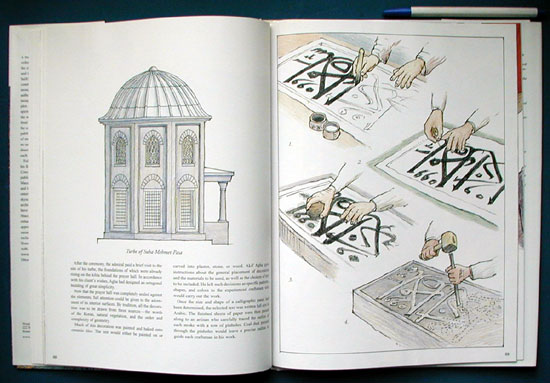
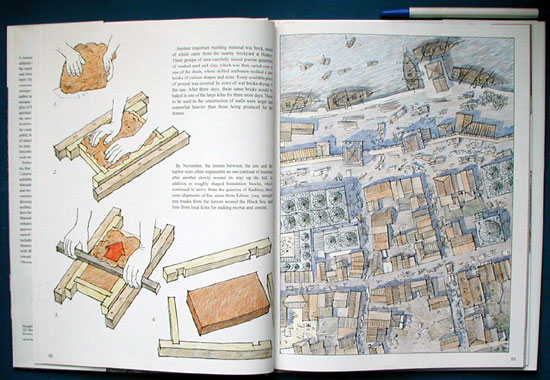
건축과 관련된 그림책인 Castle과 Cathedral로 2차례 Caldecott상을 수상한 David Macaulay가 정밀한 고증을 거쳐 17세기 터키에서 만들어진 모스크 사원의 건축과정을 세밀한 펜화그림과 함께 보여줍니다. 특히 이슬람 건축양식의 꽃이라 할 수 있는 거대한 돔 구조물을 어떻게 과학적으로 만드는지, 그리고 화려한 스테인드 글라스를 만드는 과정과 첨탑을 세우는 과정 등 흥미진진한 내용들을 세밀한 그림과 함께 자세히 소개합니다.
큰 사이즈의 페이퍼백입니다.
[ 서지 정보 ]
Edition: Paperback: 96 pages
ISBN-10: 054701547X
ISBN-13: 978-0547015477
책 크기: 30cm x 22.8cm
[ 영문 서평 ]
Book Description
A mosque rises above the city, the small, ordered domes of the compound surrounding the enormous central dome of the prayer hall and towering minaret. How was such a structure built? By whom? And why? As he describes the construction of a fictional but typical Ottoman mosque of the late sixteenth century, acclaimed author and artist David Macaulay reveals that a mosque was just one part of a much larger complex of buildings. While the mosque served the spiritual and religious needs of the community, the surrounding buildings provided education, food for its students and the needy, a place for commerce, lodging for travelers, and even public baths. Planning and building a complex of structures to serve such diverse purposes was no easy task, but here David Macaulay describes the process clearly, demonstrating each step with his spectacular illustrations.
The New York Times Book Review
''Mosque'' is a superbly illustrated and technically engrossing explanation of how a great Turkish mosque complex would be built in about 1600. It's like an erector set packed into a book....Macaulay remains respectful of Islam without fawning.
Publishers Weekly
With the level of precision and care that his fans have come to expect, Macaulay (Castle; Cathedral) broadens his bookshelf of architectural wonders with this timely new addition, adding color to his palette as well as insight into the Middle East. He whisks readers to the Ottoman empire of the 16th century, where a fictitious admiral prepares to underwrite a new mosque ("The time had come to demonstrate both his faith and his gratitude in the way that had become traditional for a man of his standing"). Macaulay meticulously illuminates the spiritual and architectural considerations in the process of design and construction; he explains the importance of the mosque's alignment upon the kibla ("an imaginary line that points toward and radiates from Mecca"), then examines its structural complexities, such as a "system of piers and arches" to support the building's domed roof. In the process, the mosque's many societal functions emerge; it is actually a complex of buildings consisting of a college for religious education, a kitchen, a public bath, fountain and so on. The monument grows stone by stone through color-washed pen-and-ink illustrations. Full-spread vistas alternate with smaller inset sketches that offer a step-by-step look at brick-making, the crafting of stained glass windows, etc.; readers can practically hear the busy hum of the worksite. Macaulay's wide-ranging perspectives pull onlookers into the thick of the construction, capturing everything from a minaret's-eye view of the activity below to an image of the soaring dome seen from the ground. As always, the level of visual detail is extraordinary; no less so is the explanation of the mosque's role at the center of Muslim social and religious life. All ages.
Children's Literature
The mosque we observe here under construction, from planning to dedication, is a fictional one, but it is based on actual buildings from the 16th century. When the aging Admiral Suha Mehmet Pasa decides to demonstrate his faith and his gratitude to his God, he calls upon architect Akif Agha to plan buildings for a charitable foundation, with a mosque as its spiritual centerpiece. The text details all the steps taken to complete the building, inside and out. The complex becomes a vital part of the life of the city. In his imaginatively attractive way, Macaulay combines accessible exposition with tinted line drawings to lead us through all the complex construction processes in ways that make them easy to follow. Pages of pictures of specific building techniques alternate with double-page scenes showing the gradual assembling of parts, with workmen at their tasks and people using the buildings at the end. He thus injects a human content into the study of technology which includes vast amounts of information. A glossary is included.
VOYA
Macaulay adds to his series of books describing buildings through visual dissections of structures with this examination of Middle Eastern mosques. Macaulay's talent enables a hefty amount of information to be presented in a minimal number of pages and illustrations. Through a wonderful blend of architectural detail, historical information, and a fictionalized story, the labor put into designing, constructing, and completing a mosque is brought to life. An informative text and appealing simple but artistic drawings bridge the gap between juvenile picture book and young adult nonfiction, making this book quite suitable for report topics. Although Islam is emphasized, featuring the five pillars of faith, prayer, charity, fasting, and pilgrimage, this book does not pretend to be a primer on the religion. Rather the importance of Islamic daily prayer plus giving back one's wealth to the community become reasons for building the mosque. Readers not familiar with the social structure of an Islamic society might be surprised to learn how a mosque is also somewhat of a social center including baths with hot and cold rooms. A minor complaint about the work is that a student with no architectural background might find descriptions of shoring up walls to support the unique dome of the building mind-boggling. That aside, because of United States involvement in the Middle East and the general population having sparse knowledge about Islamic history and culture, this title is a must-have for both school and public libraries. VOYA CODES: 5Q 4P M J S (Hard to imagine it being any better written; Broad general YA appeal; Middle School, defined as grades 6 to 8; Junior High, defined as grades 7 to 9;Senior High, defined as grades 10 to 12).
Library Journal
He's built castles and cathedrals. Now Macaulay uses his delicate but decisive drawings to show us the construction of a late 16th-century Turkish mosque.
|
| * 작가의 다른 작품(1) |
Black and White - Caldecott Medal 수상작, 하드커버, 슈퍼바이
Black and White
Caldecott Medal 수상작, 하드커버, 슈퍼바이 |
| * 최근 이 작품을 구입하신 분들의 다른 선택 |
More More More Said the Baby
Caldecott 수상작, 큰 사이즈 페이퍼백, 슈퍼바이 |
Make Way for Ducklings
Caldecott Medal 수상작, 큰 사이즈 페이퍼백, 슈퍼바이 |
Froggy Eats Out
Froggy시리즈, 페이퍼백, 슈퍼바이 |
Room on the Broom
큰 사이즈 페이퍼백, 슈퍼바이 |
|
| |
|
|< << [1] [2] [3] [4] [5] [6] [7] [8] [9] [10] >> >|
|
|
|



 전체 카테고리


 실시간 벼룩
 종류별 분류


 재고가 없는 상품