|
|
|
|
 |
 이전 | 이전 |  목록 | 다음 목록 | 다음 |
|
|
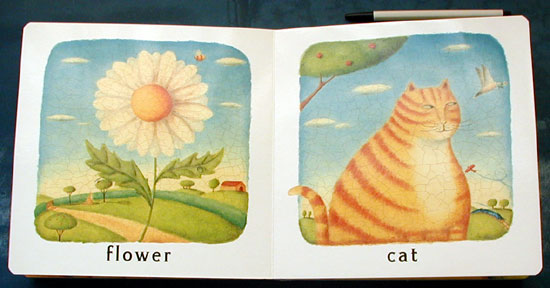
상세그림1 |
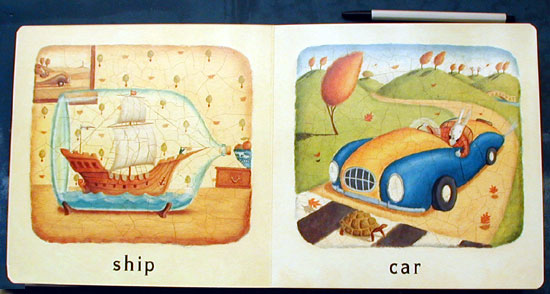
상세그림2 |
|
확대 이미지 : 상세그림1
|
확대 이미지 : 상세그림2
|
[ 책 소개 ]
언뜻 보면 주요 단어들을 클래식한 유화 그림과 함께 보여주는 책 같지만, 자세히 보면, 각 페이지들이 서로 관련이 되어 있어서 이야기를 연결해 갈 수 있습니다. 다음 페이지에 나올 그림은 앞 페이지의 그림 속에 힌트로 숨어 있으며, 또한 페이지를 넘김에 따라서 계절도 봄, 여름, 가을, 겨울로 차례로 바뀌는 것을 발견할 수 있습니다. 첫 페이지에 나오는 "Hickory Dickory Dock"을 연상시키는 시계 속에 들어 있는 4개의 그림들은 4계절을 보여주며, 좀더 구제적인 그림들이 이 책에서 펼쳐집니다.
단어들과 그림들을 이용해서 이야기를 만들면서, Guessing Game도 할 수 있는 독특한 책입니다. 비교적 큰 사이즈의 튼튼한 보드북입니다.
[ 서지 정보 ]
Reading level: Baby-Preschool
Edition : Board book: 32 pages
ISBN: 0525468285
책 크기 : 21cm x 21cm
[ 영문 서평 ]
Book Description
Simple in format, with vibrant folk-art inspired paintings of everyday items and a single, large-type word on each page, Picture This . . . is the ideal first word book for the very young. But there is much more to Picture This . . . than first meets the eye! Each turn of the page reveals a new perspective on what has come before and gives a hint of what's to come. Parents will delight in reading this book with their children, finding visual surprises together and following the gentle story as it progresses through the day and through the seasons.
Children's Literature
Each page or double-page illustration is accompanied by a single word referring to the picture. At first this seems like a simple identification. But much more emerges as we move from page to page, for each picture relates to the one before. And time and seasons also progress as forecasted by the clock's painted face at the start and on the back of the jacket/cover. The subtly simple style of the paintings suggests some recent past, reinforced by the surface crackling. One must look closely to locate the image that will be the focus of the next painting and must also note which other images are carried forward as well. For the very young, this can be used to connect a noun with an attractive visual representation. But the fun begins when the reader attends to the other pieces, to make connections that illuminate some of the mystery that seems to permeate the pages. This is a new board book version of the original picture book.
Publishers Weekly
Nostalgic images of a country landscape disguise this picture book's visual complexity. At first glance, nothing seems out of the ordinary. British author/artist Jay provides a set of gorgeous illustrations in the American primitive style, each labeled with a quaint word such as "tortoise" or "umbrella." However, the author has more than a spelling lesson in mind. The sequence begins with the lowercase word "clock" and a picture of the face of a grandfather clock, a pairing that looks easy until "Hickory Dickory Dock" enthusiasts notice the hour (almost one o'clock) and the gray mouse atop the timepiece. Decorative images surround the clock face, alluding to the four seasons and to forthcoming pictures of, for instance, a "snail" and "cat." Later in the volume, a yellow tabby refers back to the opening image of the cat pictured on the clock and also directs readers' attention to new objects, including a fire engine-red "airplane" loop-de-looping in the summer sky. Meanwhile, other visual allusions (to Jack and Jill, for example, and the Tortoise and the Hare) draw on nursery lore. The concluding winter scene, captioned simply "snowman," again recalls the clock and reactivates the book's cycle. Jay sets all the scenes in a seaside orchard among rolling hills; her luxurious palette includes custard colorsDavocado green, robin's egg blue, vanilla white and peachy goldDand the paintings have the crackled surface of antique porcelain. Fans of such brainteasers as David Wiesner's Tuesday and Joan Steiner's Look-Alikes will be charmed by this pictorial puzzler.
School Library Journal
With just one word per page, Jay takes readers on a journey through the seasons, beginning with images that decorate a clock on the very first page. Children studying the primitive-style, crackle-glazed paintings will delight in finding the nursery-rhyme look-alikes and other familiar objects. Tiny images on one page become full-sized illustrations on the next. The little snail on a golden leaf in autumn next appears larger than life, sporting an alarmed expression as a menacing red boot-worn by the girl raking leaves in the previous picture-approaches. Viewers' eyes are at once drawn across each page and yet are invited to tarry, studying each scene to find all that is hidden within. One may wonder if the couple running up the sunny hill to fetch a pail of water is the same pair pictured ice skating in a painting on the wall in a Yuletide scene. This unique book is clever enough to engage older children, yet simple enough to be a first wordbook for the youngest readers.
Booklist
Children (and readers of all ages) can spend hours poring over the whimsical, primitive-style paintings in this wordbook, not only because of their crackle-glazed charm but also because of the way each painting evolves from the previous one and moves on to the next. Each page features one word. Clock leads off, accompanied by a painting of a grandfather clock's face on which are four folk-art paintings depicting scenes from the seasons. The backdrop for all the pictures is an idyllic seaside village, and the artwork moves through the seasons and through the 24 hours of a day. Allusions to nursery rhymes and fables (the hare of the "Tortoise and the Hare" appears flying a biplane and waiting impatiently in his sports car for the tortoise to cross the road) jostle with everyday scenes to charming effect, and Jay's clever selection of visual details will challenge children to figure out what comes next (a ship at sea becomes a ship in a bottle, etc.) and encourage them to make up stories to fit the art. Jay's picture of the hare flying the airplane recently won the Children's Illustration Prize from the United Kingdom Association of Illustrators, but all the artwork here is spectacular. Connie Fletcher
Kirkus Reviews
An oddly beautiful series of images makes an evocative word book for the youngest of children. Each page holds only one word and one painting done in a naf style with muted but luminous colors and a crackled-paint finish. The first is clocka sturdy wood-framed object with pictures in the corners, Roman numerals, and a little mouse peering out. In the next, the dog (he comes from a clock picture) is chasing a ball while a male and a female figure gambol in the background; they climb up the spring-green hill of the next spread, a pail between them. You can probably guess the next picture, which indeed has them tumbling after, but the ball the dog was chasing is the main image as it bounds through an open window. Cat and fish, kite and car, books and boots, all appear in homey settings made to loom large and mysterious by their hieratic placement. As formal as the pictures are, an element of fun is introduced by spotting miniatures of items from other pages. The seasons turn, too, as we turn the pages, so that near the end, bed finds the cat and dog at the foot of the bed where a couple sleeps, the headboard festooned with Christmas garland, and a bunny and teddy bear between them. There are no children in the pages, but toys and other accoutrements place the child in this universe, alongside the bespectacled tortoise and the automobile-driving bunny. Rich in imaginative possibilities.
|
| * 최근 이 작품을 구입하신 분들의 다른 선택 |
Dave the Potter
Caldecott 수상작, 하드커버, 슈퍼바이 |
How Rocket Learned to Read
뉴욕타임즈 베스트셀러, 하드커버, 슈퍼바이 |
Shrek the Third: A Good King Is Hard to Find
An I Can Read Book, 2단계, 슈퍼바이 |
I Will Never Not Ever Eat a Tomato Pop-Up
하드커버 팝업북, 슈퍼바이 |
|
| |
|
|< << [1] [2] [3] [4] [5] [6] [7] [8] [9] [10] >> >|
|
|
|



 전체 카테고리


 실시간 벼룩
 종류별 분류


 재고가 없는 상품