|
|
|
|
 |
 이전 | 이전 |  목록 | 다음 목록 | 다음 |
|
|
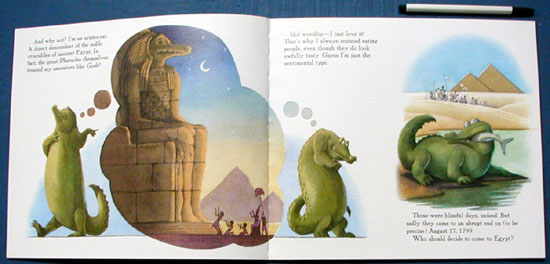
상세그림 1 |
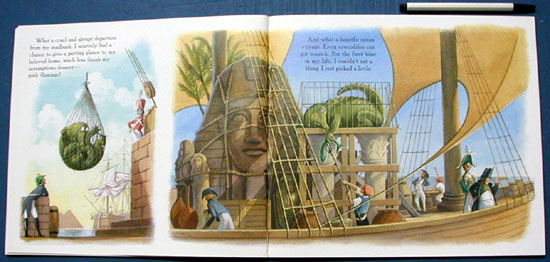
상세그림 2 |
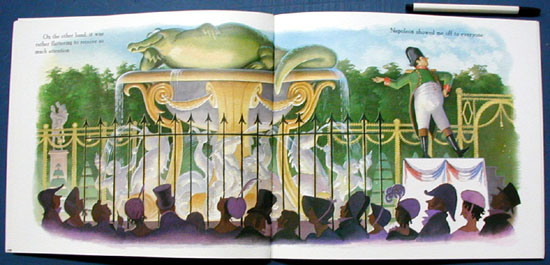
상세그림 3 |
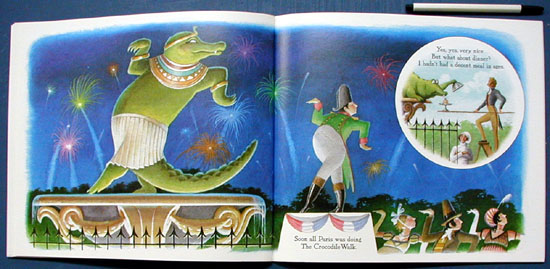
상세그림 4 |
|
확대 이미지 : 상세그림 1
|
확대 이미지 : 상세그림 2
|
확대 이미지 : 상세그림 3
|
확대 이미지 : 상세그림 4
|
[ 책 소개 ]
* 2000 ALA Notable Children's Book
* 1999 New York Times Best Illustrated Book
* 2000-2001 Georgia's Picture Storybook Award & Georgia's Children's Book Award Masterlist
자만심으로 가득차있고 식욕이 강한 이집트 악어를 나폴레옹이 1799년 파리로 데려옵니다. 악어는 다른 보물들과 함께 배에 실려와서 장식품이 됩니다. 모든 파리 사람들은 이국의 동물에 매혹당합니다. 그러나 악어는 사람들에게 구경거리가 되는 것이 싫어 파리의 지하 하수도로 들어가고...
Puss in Boots로 칼데콧 상을 수상한 Fred Marcellino의 위트가 넘치는 그림책입니다.
Lage Size 페이퍼백입니다.
[ 서지 정보 ]
Edition: Paperback: 32 pages
ISBN: 0060088591
책 크기: 28.6cm x 25.3cm
[ 영문 서평 ]
Book Description
While robbing Egypt's mummies, sphinxes, and palm trees, Napoleon can't resist bringing home a souvenir crocodile as well. All Paris is enchanted with this exotic creature. But for a crocodile with an appetite as big as his ego, being the toast of the town has its downside, too. What's a crocodile who's used to a dinner of flamingo, snake, or mongoose to make of chocolate mousse? Oh, to return to his beloved Nile! But fickle Napoleon has other plans for our hero... Inspired by an obscure nineteenth-century French satire, I, Crocodile is the first book Fred Marcellino has written as well as illustrated.
Synopsis
An Egyptian crocodile, with a big ego and a big appetite, is taken to Paris in 1799 by Napoleon Bonaparte.
Publisher's Weekly
This first picture book that Marcellino (Puss in Boots) has both written and illustrated is a pi ce de r sistance. According to the witty green narrator of this singular tale, Egypt was a paradise until "(to be precise) August 17, 1799." That day, Napoleon spoils the crocodile's bulrush idyll. Seated on a white steed, the emperor orders his troops, "Mummies! I want mummies!... And a sphinx and an obelisk. Make it a big one." In refined watercolor spreads, Napoleon's soldiers obligingly plunder temples and, as an afterthought, snare the crocodile, too. "What a cruel and abrupt departure from my mudbank," the caged reptile reports from a ship laden with Egyptian booty. The protagonist's irreverent tone serves as a perfect counterbalance for Napoleon's disrespect for Egyptian culture, and the varied use of vignettes, thought balloons and spreads keeps the pacing brisk. In one series of vignettes, Marcellino chronicles the lengthy journey and the creature's near starvation ("Was anyone keeping track of all the meals I was missing?") accompanied by its hyperbolic facial expressions. Upon reaching Paris, the crocodile achieves star status in a spread that conveys a capital worthy of its nickname, the City of Lights. Later, having fallen from favor, the croc escapes to the sewer system and, in comical facing pages, surfaces to snag a high-society lunch (feathered turban and all). Although its plump pickle-shaped body, chubby legs and devastatingly polite manner don't seem threatening, this is one stolen artifact that literally bites back. All ages.
Children's Literature
Based on a nineteenth-century satire by an unknown author, I, Crocodile is a story told from the viewpoint of a crocodile that was taken from the Nile and transported to Paris by Napoleon Bonaparte. While in Egypt, the crocodile was the king of the Nile and, upon arriving in France, he becomes the toast of society. The only problem was that the crocodile was unable to get a decent dinner in France. Soon, Mr. Crocodile becomes old news, and one day Napoleon begins to think of dinner--his own! And he thinks of the main dish--Crocodile Pie with Egyptian Onions! This book features comical illustrations that are large and colorful. Older children will enjoy the story while gaining a sense of appreciation for the absurd. - Ru Story-Huffman
Library Journal
Marcellino's first foray into writing is for seasoned picture-book readers. Children will be intrigued by the cover art-an enormous crocodile sitting on Empire-style furniture at a garden party, hungrily eyeing the guests, his menu upside down. In fact, the watercolors throughout are delightful: the oversized Egyptian reptile picturing his aristocratic ancestors (carved in stone, godlike) or performing the Crocodile Walk (bedecked in pleated skirt and breastplate) after being captured by Napoleon and installed as a fountain decoration in Paris. The pages are designed to present this crocodile of enormous ego almost as a screen star, right down to the playful iris shots in which he dreams of food. He escapes the cook's cleaver by diving into the sewer but has a problem securing food, until an upper-crust dilettante, seen in one scene and only a hat in the next, temporarily solves his dining dilemma. The jacket notes that the story was inspired by "a nineteenth-century satire by an unknown French author." This adaptation of French colonialism run amok is conveyed through a witty monologue that combines highbrow and colloquial elements. The story, however, is not as strong as the art; the singlemindedness of this animal with an attitude starts to wear thin. While sophisticated kids will find much to enjoy, general program audiences may prefer such reptilian hits such as Tomie dePaola's Bill and Pete Go Down the Nile (Putnam, 1987), Gail Jorgensen's Crocodile Beat (Aladdin, 1994), or Baba Diakite's The Hunterman and the Crocodile (Scholastic, l997).-Wendy Lukehart, Dauphin County Library, Harrisburg, PA Copyright 1999 Cahners Business Information.
Parents' Choice?
There are few picture-book artists as gifted or versatile as Fred Marcellino. And so, this first book both written and illustrated by him is of far more than routine interest. "A direct descendant of the noble crocodiles of ancient Egypt", this reptilian hero is a shameless scene stealer whose greatest joy is eating. "(Actually, overeating.)" When he is captured and shipped to France by no less a personage than Napoleon, he is "an overnight sensation!....The Toast of the Tuileries!" But alas, his ego is better fed than his voracious appetite. Children will be enchanted by the crocodile's ridiculous shenanigans and possibly just a bit shocked by his unexpected solution to the problem of finding a satisfactory meal. The story is weak, however, and far less compelling than Marcellino's inspired pictures. (Selma G. Lanes, Parents' Choice?, 2000)
From Kirkus Reviews
More stylish invention from Marcellino (Natalie Babbitt's Ouch!, 1998, etc.), inspired by a 19th-century satire. While munching contentedly on a flamingo, a Nile crocodile is suddenly set upon by ``bozos with funny hats and a big net,'' who at the behest of Napoleon cart him off to a Parisian fountain for public display. Soon he's the ``Toast of the Tuileries,'' but fashion is fickle, and when the crocodile hears that he's slated to become a pie he makes his escape. Where? Into the sewers, of course. Crocodile tells his tale in a disingenuous tone not unlike that of A. Wolf, narrator of Jon Scieszka's True Story of the Three Little Pigs (1989); the grand illustrations depict a rotund reptile with googly eyes, grimacing and posturing theatrically before crowds of bonneted and cockaded Parisians. He's such an engaging sort that readers will surely forgive him for pulling down an occasional unwary passerbya crocodile must eat, after all.
About the Author
Fred Marcellino's picture books include Puss in Boots, a Caldecott Honor Book; The Steadfast Tin Soldier, an ALA Booklist Children's Editors' Choice; and The Pelican Chorus, one of School Library Journal's Best Books of the Year.
His most recent books, The Story of Little Babaji and Ouch! are both ALA Notable Children's Books.
DANCING BY THE LIGHT OF THE MOON: The Art of Fred Marcellino will open on November 9, 2002 and run through January 26, 2003 at The Norman Rockwell Museum in Stockbridge, Massachusetts. This is a comprehensive show of more than 150 pieces highlighting his children's book career, and the first museum retrospective honoring the artistic accomplishments of this remarkable artist. For more information visit, The Norman Rockwell Museum website.
|
| * 최근 이 작품을 구입하신 분들의 다른 선택 |
The Worry
Less |
Michelangelo
A School Library Journal Best Book, 페이퍼백 |
Miss Daisy Is Still Crazy!
My Weirdest School, Book 5, 페이퍼백, 슈퍼바이 |
Orphan Train Rider: One Boys True Story
Boston Globe-Horn Book Award 수상도서, 슈퍼바이 |
|
| |
|
|< << [1] [2] [3] [4] [5] [6] [7] [8] [9] [10] >> >|
|
|
|



 전체 카테고리


 실시간 벼룩
 종류별 분류


 재고가 없는 상품