|
|
|
|
 |
 이전 | 이전 |  목록 | 다음 목록 | 다음 |
|
|
상세그림1 |
상세그림2 |
|
확대 이미지 : 상세그림1
|
확대 이미지 : 상세그림2
|
[ 책 소개 ]
* IRA/CBC Children's Choice
* Prairie Bud Award 수상작
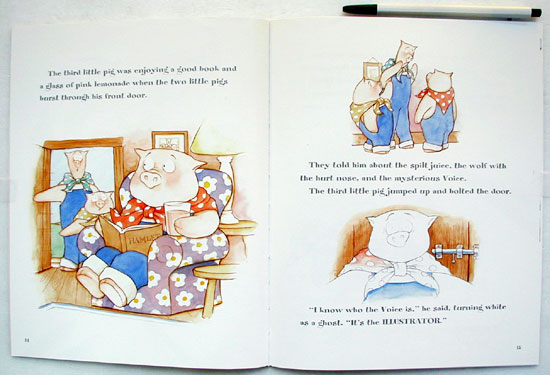
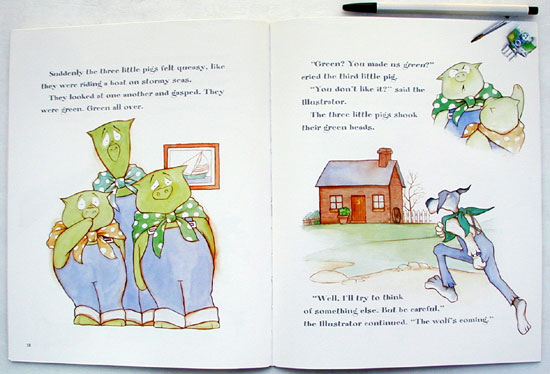
아기 돼지 3형제의 이야기를 재미있게 재구성한 내용입니다. 아기돼지 3형제가 집을 짓습니다. 막내는 짚단으로, 둘째는 나무로, 그리고 맏이는 돌로 지었지요. 그리고 마침내 늑대가 막내 집에 나타나고... 여기까지는 원래 이야기대로 진행이 됩니다. 그런데 막내 집에 누군가가 쥬스를 뒤집어 씌우네요. 그리고 어디선가 들리는 목소리 "이런! 쥬스를 쏟아버렸네." 늑대가 입으로 훅 불어서 짚단으로 만든 집을 쓰러 뜨리기 전에 쥬스에 흠뻑 젖어버린 집이 스스로 허물어 집니다. 둘째가 지은 나무로 만든 집에 늑대가 찾아 왔을 때 이번에는 늑대의 코가 지워지기 시작하네요. 그리고는 어디선가 들리는 목소리. "이런. 늑대 코를 다시 그려야겠네." 막내와 둘째는 맏이의 집으로 도망을 가서 자초지종을 얘기해줍니다. 영리한 맏이는 그 얘기를 듣고 그 목소리의 주인공이 누구인지 바로 깨닫습니다. 바로 이 책의 그림을 그리는 Illustrator의 목소리였죠. 그리고 여기서부터 아기돼지 3형제와 늑대 간의 이야기에 Illustrator의 이야기까지 추가되어서 엉뚱한 방향으로 스토리가 전개됩니다. 빨간 물감이 떨어진 Illustrator는 항의하는 돼지들을 녹색이나 꽃무늬로 바꾸기도 하고, 벽돌집의 굴뚝으로 들어오는 늑대를 쫓아버리기 위해 벽난로에 장작으로 불을 피웁니다만, 빨간 물감이 없다보니 전혀 뜨거워지지 않는 등... 이야기가 뒤죽박죽이 됩니다. 마침내 아기 돼지 3형제는 더 이상 이 이야기의 주인공이 되고 싶지 않다고 항의를 하자, 빨간 물감이 떨어진 Illustrator는 돼지 3형제와 늑대를 곰 3마리와 골디락으로 변신을 시키네요...
유머와 기발한 상상력이 가득한 재미있는 내용입니다.
[ 서지 정보 ]
Edition: Paperback: 32 pages
ISBN: 0064435466
책 크기: 25.3cm x 20.4cm
[ 영문 서평 ]
From the Publisher
All the three little pigs want to do is move out of their crowded home (where seventy-three other little pigs live) and build their own little houses. But wait! What's that sticky orange juice doing on the first little pig's straw house? And why is the second pig turning green? And what does it all have to do with the mysterious voice the pig keep hearing? Full of surprises, laughs, and hilarious wordplay, this quirky retelling of "The Three Little Pigs" encourages readers to look at this favorite story in a whole new way.
Children's Literature
Beginning from the classic tale of the Three Little Pigs, this soon moves from the traditional building of houses and running from the big bad wolf to the most unusual interruption of a Voice, who turns out to be the Illustrator. His lack of red paint causes not only pale pigs but sickly green and patterned pigs, while the wolf huffs and puffs away. The angry pigs demand to be let out of the story, whereupon the Illustrator gives us the last laugh, in this new romp with an old tale. Three anthropomorphic pigs in blue coveralls and polka-dot neckerchiefs are stylized porkers with big round white eyes, spike-y ears, and barely a mouth, active in vignettes, while the wolf has a wonderfully extensive range of facial expressions. In contrast, finely detailed pictures of a spilled glass of juice, an empty paint tube, a brush, a pencil, or an eraser remind us that we are in an art world where strange things can happen.
School Library Journal
Although familiar elements from "The Three Pigs" are included here, several threads are new. A cup of juice spills on the first pig's straw house, causing it to collapse before the wolf blows on it, and the wolf's nose is erased and redone after he slams into the door of the second pig. It turns out that the force behind these events is the Voice, which belongs to the illustrator. He has run out of red paint and so the pigs are white. After making them green, patterned, and polka-dotted, and realizing that with no red paint there can be no fire to boil the wolf, the four characters are given a whole new identity. Children will laugh at the last picture in which the characters are placed into the story of "Goldilocks." The book will be of great help in starting discussions on what an illustrator does. The pigs' expressions are priceless; their exasperation at being the wrong color comes through clearly. Whatley's accessible variation joins David Wiesner's unique vision and masterful technique in The Three Pigs (Clarion, 2001) and Barry Moser's humor in The Three Little Pigs (Little, Brown, 2001).
Kirkus Reviews
Poor pigs! Not only do the Three Little Pigs have to contend with their old nemesis the Big Bad Wolf in the third visit this year, they also find themselves at the mercy of The Illustrator. The first inkling that all is not well comes when a mysterious Voice from nowhere spills juice all over the first little pig's straw house: a dismayed pig stares down at his house, which is partially obscured by an orange puddle and an overturned glass. The illustrator is an equal-opportunity meddler, giving the first and second little pigs time to escape to their brother's house by redrawing the wolf's nose. But the real problems start when the illustrator informs the pigs that they have all gone pale because he has run out of red paint—a squeezed-out tube of red paint appears on the corner of the page as corroborating evidence. The interplay between the infuriated and befuddled characters and the illustrator continues, with the pigs and the other elements of their story drawn as cartoons and the illustrator's paints and other artifacts appearing realistically on top of the plane of the page. This sort of self-conscious recognition of the artifice behind a picture book is nothing new; recent examples include Chris Van Allsburg's A Bad Day at Riverbend and Jackie French Koller's One Monkey Too Many—not to mention I Love Going Through this Book, by Robert Burleigh. By setting this concept within such a familiar tale heightens the artifice, Whatley (Captain Pajamas) allows children to explore it on one level while enjoying a fractured fairy tale on another. It's a sophisticated concept, though-use it with children who are beginning tounderstand what an illustrator is, and pair it with Janet Stevens's From Pictures to Words for a thorough treatment.
|
| * 최근 이 작품을 구입하신 분들의 다른 선택 |
Sounder
Newbery Medal 수상도서, 슈퍼바이 |
Fancy Nancy: Ooh La La! It's Beauty Day
페이퍼백, 슈퍼바이 |
Action Jackson
뉴욕타임즈 올해의 책 수상도서, 페이퍼백 |
Shapes, Shapes, Shapes
School Library Journal Best Book of the Year, 페이퍼백, 슈퍼바이 |
|
| |
|
|< << [1] [2] [3] [4] [5] [6] [7] [8] [9] [10] >> >|
|
|
|



 전체 카테고리


 실시간 벼룩
 종류별 분류


 재고가 없는 상품