|
|
|
|
 |
 이전 | 이전 |  목록 | 다음 목록 | 다음 |
|
|
상세그림1 |
상세그림2 |
|
확대 이미지 : 상세그림1
|
확대 이미지 : 상세그림2
|
[ 책 소개 ]
* ALA Notable Children’s Book
* IRA/CBC Children's Choice
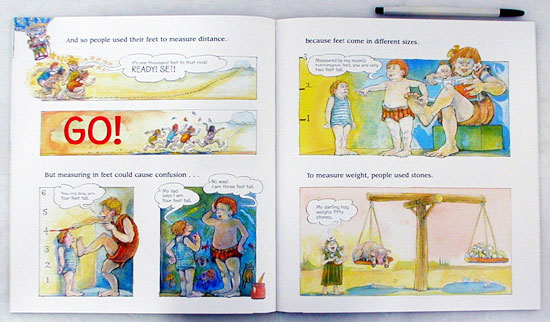
수학마술사 마블로시시모가 등장하는 책인 How Much Is a Million?과 If You Made a Million에 이어, 이 책에서는 무게, 부피, 길이 등을 측정하는 법을 유머러스한 그림을 통해 쉽고 재미있게 설명해 줍니다.
옛날 사람들은 길이를 측정하기 위해 발의 길이(feet)를 사용하고 무게를 측정하기 위해 돌의 갯수 등을 사용하였으나, 사람마다 발길이가 다르고, 돌마다 무게가 다르기 때문에 정확한 측정을 할 수 없었습니다. 그래서 사람들은 어디서나 측정단위가 통일되어 하나로 사용될 수 있도록 "표준"이라는 개념을 사용했으며, 측정단위인 피트(길이), 파운드(무게), 컵(부피) 등은 어디서나 동일하게 사용되었습니다.
그리고 측정단위는 점차 세분화되어서
- 길이는 인치, 피트(12인치), 야드(3피트), 마일(1,760야드)
- 무게는 온스, 파운드(16온스), 톤(2000파운드)
- 부피는 티스푼, 테이블스푼(3티스푼), 온스(2테이블스푼), 컵(8온스), 핀트(2컵), 쿼트(2핀트), 겔런(4쿼트) 등이 만들어 졌습니다.
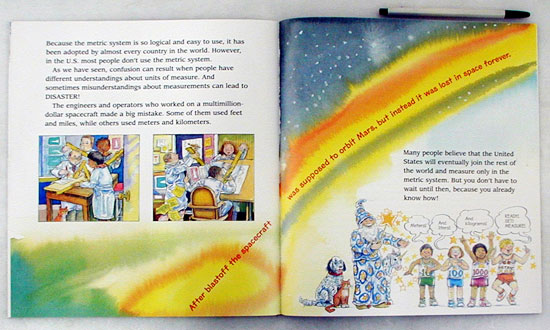
하지만 이런 측정법은 규칙성이 없이 너무나 복잡하기 때문에 좀더 쉽고 정확한 측정을 위해 1970년대에 프랑스의 사제에 의해 10진법을 기본으로 하는 미터법이 생겨납니다. 길이는 미터, 무게는 그램, 부피는 리터를 사용하며, 1/1000은 단위 앞에 밀리, 1/100은 센티, 그리고 1000배는 킬로를 붙이면 되는 간단한 방법입니다. 세계 대부분의 국가가 미터법을 사용하는데 반해, 오직 미국만이 피트나 온스 같은 옛날 방식의 측정법을 계속 사용하고 있습니다만, 미국에서도 미터법 사용을 주장하는 목소리가 점차 커지고 있습니다...
[ 서지 정보 ]
Edition: Paperback: 40 pages
ISBN-10: 0060848065
ISBN-13: 978-0060848064
책 크기 : 27.2cm x 25.3cm
[ 영문 서평 ]
Annotation
Marvelosissimo the Magician explains the development of standard units of measure, and shows the simplicity of calculating length, height, weight, and volume using the metric system.
From the Publisher
Your favorite wizard is back -- and ready to explore the invention of length, weight, and volume measurements. How tall is Moonbeam, the unicorn? How long are the whiskers of Jello, the cat? And just how heavy is that darling hog? Tons and teaspoons and ounces and feet and yards and miles ... what a headache! With millions of things to measure, wouldn't one standard system be simpler?
With another wave of the wand, Marvelosissimo introduces you to the world of metrics and makes it easy to understand the basic pattern of meters, liters, and grams. And with Steven Kellogg's playful and delightfully detailed illustrations, measuring has never been such a blast!
Publishers Weekly
The team behind How Much Is a Million? presents an eye-opening exploration of measurement, with special emphasis on the metric system.
Children's Literature
As he did in his book How Much Is A Million? author David M. Schwartz has created a second fun picture book that successfully teaches kids complex concepts. Here, he breaks down measurement systems into bite-size pieces that kids can put together to measure distance, weight, and size. First he explains how foot-long rulers, one-pound blocks, and the royal cup became standard measures. Then he explains that three feet equal a yard and that longer distances are measured in miles. He explains that weight is measured in pounds, that two thousands pounds equals a ton, and that ounces are used for weights less than a pound. All the while, he is leading up to the advantages of using the metric system, which has been adopted by nearly every country in the world. Though the United States has yet to fully adopt the metric system, Schwartz encourages kids to learn it so they can measure "like a world citizen." The colorful illustrations by Steven Kellogg are delightful. 2006, HarperTrophy
School Library Journal
The creators of How Much Is a Million? (1985) and If You Made a Million (1989, both Lothrop) bring forth another great resource in this book about weights and measures. Marvelosissimo the Mathematical Magician returns, this time to teach kids about how measurement was developed many years ago, and was first based on feet. The book traces the development of standard units of measure for distance, weight, and volume, then describes the development of the metric system in the late 1700s. A three-page appendix offers more in-depth information about the metric system. Kellogg's trademark whimsical illustrations clarify the concepts presented. As in the previous books, Schwartz presents them in a logical, step-by-step progression, with plenty of examples to provide practical context. The text is clear and brief enough for classroom presentation. This book is sure to join its predecessors as a staple.
Kirkus Reviews
Marvelosissimo the Mathematical Magician returns, this time tackling measurement, in this latest installment of the winning "millions" series (If You Made a Million, 1989, etc.). In his systematic and logical style, Schwartz presents an enormous amount of information in an impressively clear and concise manner, beginning with the history of standardized measuring units. Through a series of "bright ideas," the narrative arrives in the modern day, delving into current methods of measuring weight, length, and volume in the US. However, as the complexities of these systems are revealed, it seems another bright idea is needed, and--voil?-the metric system is introduced. Kellogg뭩 busy illustrations are jam-packed with color and exquisite detail. With plenty of dialogue (via text bubbles) and tons of eccentric characters from cavemen to kings to unicorns, the art is as fun to explore as it is functional. To give a sense of real-life scale, inchworms are placed next to foot-long snakes, and a hippo뭩 water bowl is pitted against a cat뭩. Accurately sized rulers are depicted, including a foldout meter at the center. A lengthy author뭩 note supplies further, detailed information about the metric system and a plea to "think metric" in everyday life. Although Schwartz뭩 intention is to make a point about the relative simplicity of the metric system, he does not neglect American standards, and thereby keeps the work relevant--it can serve as an introduction to measuring, and can also function as a reference guide. The Schwartz-Kellogg team has got it right again: this should be part of every professional collection.
|
| * 최근 이 작품을 구입하신 분들의 다른 선택 |
The Magic Fan
페이퍼백, 슈퍼바이 |
Miss Daisy Is Still Crazy!
My Weirdest School, Book 5, 페이퍼백, 슈퍼바이 |
Bye-Bye, Mom and Dad
Little Critter시리즈, 페이퍼백, 슈퍼바이 |
Find Spot at Preschool
A Lift-the-Flap 보드북, 슈퍼바이 |
|
| |
|
|< << [1] [2] [3] [4] [5] [6] [7] [8] [9] [10] >> >|
|
|
|



 전체 카테고리


 실시간 벼룩
 종류별 분류


 재고가 없는 상품