|
|
|
|
 |
 이전 | 이전 |  목록 | 다음 목록 | 다음 |
|
확대 이미지 : 내용보기1
|
확대 이미지 : 상세보기2
|
확대 이미지 : 내용보기3
|
[ 책 소개 ]
인종차별이 성행하던 아프리카의 남아공에서 평등, 정의, 평화를 위해 헌신해 온 공로로 노벨 평화상을 받았던 투투 대주교가 어린 아이들에게 전하는 메세지를 아름다운 그림과 함께 보여줍니다.
서로 존중받고, 마음 속으로부터 자유로우며, 서로 나누고 돌보며, 서로 친해지고, 서로를 용서하고 눈물을 닦아주며, 언어와 종교와 생김새가 달라도 모두를 똑같이 사랑하는 것이 신이 꿈꾸는 아름다운 세상이라는 이야기를 어린 아이들에게 들려 줍니다.
큰 사이즈의 튼튼한 하드커버책입니다.
[ 서지 정보 ]
Edition: Hardcover: 40 pages
ISBN-10: 0763633887
ISBN-13: 978-0763633882
책 크기 : 29.5cm x 25.5cm
[ 영문 서평 ]
Book description
With warmth and humor, Archbishop Desmond Tutu distills his philosophy of unity and forgiveness into a picture book for the very young.
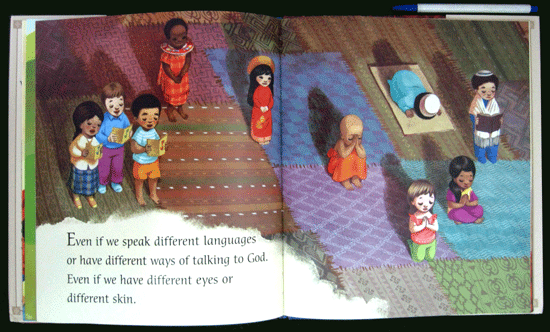
Archbishop Desmond Tutu has a vision of God's dream, which he shares here with the youngest of listeners. It involves people who reach out and hold each other's hands, but sometimes get angry and hurt each other - and say they're sorry and forgive. It's a wish that everyone will see they are brothers and sisters, no matter their way of speaking to God, no matter the size of their nose or the shade of their skin. Aided by vibrant artwork evoking such images as a rainbow and a sharing circle, Tutu offers the essence of his ubuntu philosophy, a wisdom so clear and crystalline that even the smallest child can understand.
Publishers Weekly
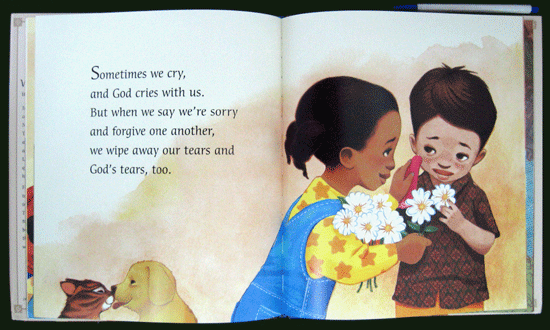
Just as children have dreams, say Archbishop Tutu and Abrams (previously paired with Tutu for God Has a Dream: A Vision of Hope for Our Time), so does God: "God dreams that every one of us will see that we are all brothers and sisters-yes, even you and me-even if we have different mommies and daddies or live in different faraway lands." The authors understand that direct prose can often be the most reassuring; they tell readers, "God does not force us to be friends or to love one another.... But when we say we're sorry and forgive one another, we wipe away our tears and God's tears, too." Pham (Big Sister, Little Sister) forgoes much of the impishness that enlivens her best titles, but even though she's working with familiar brotherhood-of-man tropes (a global cast of children, some wearing non-Western clothes, gather in a single, idyllic location to play and worship), she nimbly sidesteps triteness through her velvety, saturated palette and the unassuming sweetness of her characterizations. This is not a book to win converts, but a wide range of believers, including children at the younger end of the target audience, should respond to its heartfelt appeals.
School Library Journal
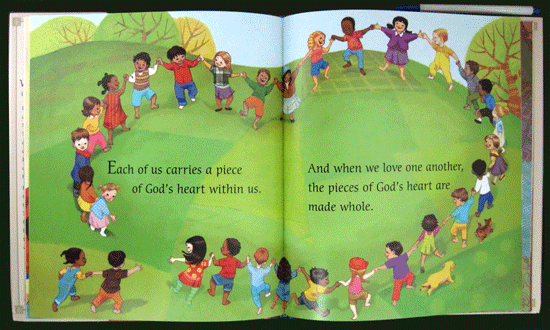
Tutu teaches a message of peace and hope in this gentle picture book, echoing the theological ideology of his memoir, God Has a Dream: A Vision of Hope for Our Time (Doubleday, 2004). "Dear Child of God," the narrator begins, "what do you dream about?" While children may dream about "flying high" or "being treated like a full person," God dreams about a world in which all of his children join hands in peace, reconciliation and unity. In simple, eloquent language, Tutu conveys the message that although we come from different lands, have different eyes and skin, and talk to God in different ways, we are still brothers and sisters. By "sharing, loving, caring" and "knowing we are family" we can "make God's dream come true." The incandescent graphite, watercolor, and ink illustrations of captivating multicultural youngsters engaged in the carefree pastimes reinforce the overarching themes of love and inclusiveness. The angelic, trusting faces reflect the hope that Archbishop Tutu holds for all the world's children of God. They hold hands and share welcoming smiles, creating a circle of love and acceptance. Parents may want to pair this inspirational book with Karen Lynn Williams's Circles of Hope (Eerdmans, 2005) or Alice McGinty's Thank You, World (Dial, 2007), two more stories exploring the importance of love, faith, and hope.
Kirkus Reviews
Archbishop Tutu shares his philosophy in simple but eloquent words intended for young children, accompanied by Pham's appealing illustrations of sweet-faced children of different ethnicities. A brief introduction about a child's dreams segues into a lyrical look at what God's dreams must be: for a world of sharing, caring, forgiveness and tolerance of differences. These basic but important concepts are presented in easy-to-understand terms, such as the twin needs to apologize and forgive after an argument. The message that we are all brothers and sisters despite our differences is clearly conveyed in the tale, which concludes with a crowd of smiling children creating a rainbow with their own handprints. An extra-large trim size and big, bright illustrations make this a fine choice for reading to a group. The noteworthy illustrations include a touching spread showing children of different faiths all praying in their own way and attractive endpapers with a patchwork of African patterned fabrics.
|
| * 최근 이 작품을 구입하신 분들의 다른 선택 |
The Tomten
An ALA Notable Book, 페이퍼백, 슈퍼바이 |
The Village of Round and Square Houses
Caldecott수상작, 하드커버, 슈퍼바이 |
Mirette on the High Wire
Caldecott Medal 수상작, 페이퍼백, 슈퍼바이 |
Phones Keep Us Connected
Let's-Read-and-Find-Out Science, Level 2, 슈퍼바이 |
|
| |
|
|< << [1] [2] [3] [4] [5] [6] [7] [8] [9] [10] >> >|
|
|
|



 전체 카테고리


 실시간 벼룩
 종류별 분류


 재고가 없는 상품