|
|
|
|
 |
 이전 | 이전 |  목록 | 다음 목록 | 다음 |
|
|
상세그림 1 |
상세그림 2 |
|
확대 이미지 : 상세그림 1
|
확대 이미지 : 상세그림 2
|
[ 책 소개 ]
Harper Collins의 Let's-Read-and-Find-Out Science시리즈는 과학의 기본개념을 알기 쉽게 소개하며 어린 아이들의 과학, 기술, 자연에 관한 다양한 호기심과 궁금증을 해결해 줄 수 있는 우수한 어린이 과학도서입니다.
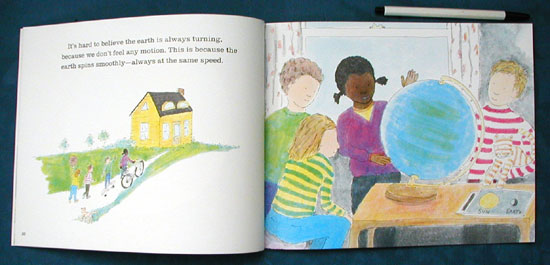
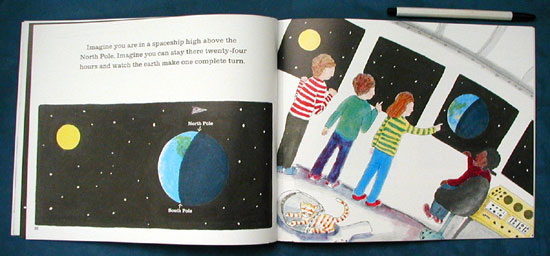
이 책에서는 지구의 자전에 의해 밤과 낮이 생기는 것을 선명한 사진 및 그림, 그리고 간단한 실험을 통해 쉽고 재미있게 설명합니다.
[ 서지 정보 ]
Edition: Paperback: 32 pages
ISBN: 0064450503
책 크기: 25cm x 20cm
[ 영문 서평 ]
Annotation
A simple explanation of how the rotation of the earth causes night and day.
From the Publisher
‘Accompanied by NASA photographs and Dorros’s colorful, lively drawings, the text explains the Earth’s rotation in clear and simple terms. An experiment using a lamp as the ‘sun’ further clarifies the principles introduced.’ —BL.
School Library Journal
What Makes Day and Night is an enormous improvement over the 1961 edition: less repetitive, much clearer in presentation and more specific about physical phenomena. However, brevity causes some of the explanations to be oversimplified, and some further explanations may be necessary. The illustrations are better, featuring clear, colorful and sometimes mildly silly scenes that add some playfulness. The simple science experiment remains from the old edition, and Branley has included a new discussion of day and night on the moon, as well as a photo of our planet taken from space. Gail Gibbons' Sun Up, Sun Down (HBJ, 1983) is a broader, shallower treatment. Use the new revision of the 1963 edition of The Moon and What It's Like to replace the old edition or to supplement more general titles. It reports on the Apollo program and its findings. Instances of stridency (``The Moon is a dead world. It has never had living things on it. It is dead, lifeless and colorless'') and oversimplification (``There is no water anywhere on the Moon''probable but not proven) aside, this is a good first introduction to the subject, neither too technical nor diluted to blandness. The illustrations combine a few unimpressive photos (they're poorly exposed, or not well reproduced, or both) with a new set of simple, clear, uncluttered drawings, including a map showing the Apollo landing sites. As with other books in the series, Branley avoids superficiality by severely limiting his topic. John Peters, New York Public Library
|
| * 작가의 다른 작품(3) |
The Sun: Our Nearest Star - Let's-Read-and-Find-Out Science, Stage 2
The Sun: Our Nearest Star
Let's-Read-and-Find-Out Science, Stage 2 | The Sky Is Full of Stars - Let's-Read-and-Find-Out Science. Stage 2, 슈퍼바이
The Sky Is Full of Stars
Let's-Read-and-Find-Out Science. Stage 2, 슈퍼바이 | Down Comes the Rain - Let's-Read-and-Find-Out Science, 2단계
Down Comes the Rain
Let's-Read-and-Find-Out Science, 2단계 |
| * 최근 이 작품을 구입하신 분들의 다른 선택 |
Rumble! Roar! Dinosaurs!: A Prehistoric Pop-Up
페이퍼백, 팝업북, 슈퍼바이 |
Peter Pan
Robert Sabuda 팝업북, 슈퍼바이 |
Little Beaver and the Echo
Parents Magazine Best Books of the Year, 페이퍼백, 슈퍼바이 |
Animal Architects
National Geographic Readers, Level 3, 슈퍼바이 |
|
| |
|
|< << [1] [2] [3] [4] [5] [6] [7] [8] [9] [10] >> >|
|
|
|



 전체 카테고리


 실시간 벼룩
 종류별 분류


 재고가 없는 상품