|
|
|
|
 |
 이전 | 이전 |  목록 | 다음 목록 | 다음 |
|
|
상세그림 |

상세보기2 |
|
확대 이미지 : 상세그림
|
[ 책 소개 ]
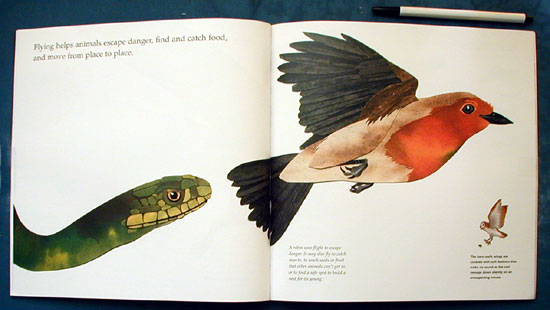
"What Do You Do with a Tail Like This?"로 2004년 Caldecott 상을 수상한 Steve Jenkins의 작품입니다. 이 책에서는 하늘을 나는 동물들에 관한 흥미로운 Facts를 아름답고 세밀한 콜라쥬 그림과 함께 재미있게 배울 수 있습니다.
이 책에 수록된 내용의 예시를 들면...
- 잠자리는 약 3억 5천만년 전부터 번성해 왔으며, 당시에는 날개 폭이 75cm에 이를 정도로 거대한 크기였습니다.
- 2억 5천만년 전에 출현한 하늘을 나는 공룡인 익룡은 날개 길이만 해도 12미터에 달할 경도로 거대했습니다.
- 1억 5천만년 전에 살았던 최초의 조류인 시조새는 날개에는 깃털이 있었지만, 피부는 파충류처럼 비늘로 덮여 있었습니다.
- 그외 에도 날개의 형태, 나는 방법의 차이, 날개가 퇴화된 조류, 하늘을 나는 유일한 포유류인 박쥐의 신비, 하늘을 나는 것이 아닌 활공하는 동물들, 기장 크고 가장 작고 가장 빠른 나는 동물들, 인간의 하늘을 날기 위한 노력 등 하늘을 나는 동물들에 관한 흥미진진한 내용들이 폭넓게 포함되어 있습니다.
[ 서지 정보 ]
Edition: Paperback: 32 pages
ISBN: 0618548823
책 크기: 24.2cm x 24cm
[ 영문 서평 ]
Book Description
Wings carry tiny insects, fluttering butterflies, backyard birds, and they even propelled some dinosaurs up and through the skies. Find out how, when, and why birds and beasts have taken to the air, and discover how wings work in this informative and brilliantly illustrated book about flight.
Children's Literature
Birds do it; bees do it; a few dinosaurs did it; and only one species of mammal does it. What do they all have in common? The ability to fly. Beginning with insects, the authors present the animals that fly in the order in which they first appeared on earth. They discuss how wings help them fly and the advantages of flying. Various types of gliders, such as the flying squirrel, are presented, along with the reasons they cannot fly. World record flyers, such as the big brown bat, the arctic tern and the monarch butterfly, are listed. A two-page spread provides a very brief look at the evolution of mankind's flying machines. The picture book format makes this a fine introduction for a variety of age groups—the brief, large print text will give preschoolers an understanding of why some animals can fly; school-age children will benefit from the tidbits of information in the small print and the notes at the end. A short bibliography will lead them to further research. The large, main illustrations are done in paper collage and reproduced so well the reader will want to touch them. Some of the sidebar illustrations are computer generated.
Parent Council Reviews
Anyone fascinated with flight can discover how, when, and why birds and beasts have taken to the air. Learn how wings work in this informative and beautifully illustrated book. Cut paper illustrations make subjects pop off the page. Very nice.
School Library Journal
After reading fascinating facts on the diverse creatures that fly, students can focus their research on any one of the fliers illustrated on the double-page spreads.
Kirkus Reviews
An ambitious but unsuccessful design combines three levels of narration in this exploration of the concept of flight in the animal kingdom. Jenkins (Bugs Are Insects, p. 665, etc.) and Page create a basic storyline with double-page spreads each featuring one creature in flight, illustrated with Jenkins's brilliant, realistic cut-paper collages. The top of each spread includes just one or two sentences set in large type, which could be read by young readers themselves or by an adult as a read-aloud. The second layer of narration is set in smaller, italic type, serving as captions for the illustrations. The third, more problematic layer of narration goes deeper in some related direction (or in several directions), for example, explaining the mechanics of a hummingbird's wing movement. These related text blocks are set in even smaller type accompanied by small, computer-generated illustrations. A final spread offers an additional paragraph of information on each of the animals covered. A nonfiction work for children can't be all things for all ages, and this effort tries to be both a read-aloud for younger children and a nonfiction title for older ones, failing on both levels. The print in the third level of narrative is really too small for anyone to comfortably read, and the effect of all the levels of information, three different type faces, and the cluttered page design serves to dilute the impact of the attractive cut-paper collages. This overloaded concept never gets off the ground.
|
| * 최근 이 작품을 구입하신 분들의 다른 선택 |
Happy Birthday, Danny and the Dinosaur!
An I Can Read Book, 1단계, 슈퍼바이 |
Fancy Nancy at the Museum
An I Can Read Book, 1단계, 책과 CD 세트, 슈퍼바이 |
Henry the Fourth
Mathstart, Level 1 |
Mr. Hynde is Out of His Mind!
My Weird School, 슈퍼바이 |
|
| |
|
|< << [1] [2] [3] [4] [5] [6] [7] [8] [9] [10] >> >|
|
|
|



 전체 카테고리


 실시간 벼룩
 종류별 분류


 재고가 없는 상품